
There is often a phase where a certain baseline has been established, and the system can hold a bit more than before but without being resolved in any meaningful way. What becomes noticeable is not a return to normal, but a slightly wider range of what seems possible, even if that range remains limited and inconsistent.
For some, life was never fully paused. Work, responsibilities, or existing structures may have continued in some form, but under increasing strain. Adjustments become necessary not only because something is wrong, but because overall energy is no longer sufficient to carry everything in the same way as before. This may be driven by personal choice — projects, interests, or a desire to stay engaged — but often also by external factors such as financial pressure, family responsibilities, or simply the reality of everyday life.
In that context, adaptations start to play a role early on. Not as a strategy, but as a necessity.
It also becomes clear that not all forms of stress can be cleanly separated into “good” or “bad.” Some things give structure, connection, or meaning while still draining the system. Others feel purely demanding. At the same time, even positive or meaningful activities can exceed current capacity, while certain draining aspects remain unavoidable. The distinction exists, but it does not remove the constraint.
What matters more is that all of these elements draw from the same underlying system.
Energy Management
1. Stabilise
Build a baseline.
2. Know your limits
Learn your early signs.
3. Your energy is limited
100% today
may be 30–50%
of your old 100%.
4. Choose wise
Small steps.
5. Adapt to make it last
Adjust how you do things.
Seen this way, the question shifts. It is less about whether something can be done at all, and more about what it costs in relation to everything else within the same day or week.
This is where adaptation becomes practical. Not as a fixed method, but as a way of making things work despite limited capacity. Activities are not simply added back in — they are changed, reduced, supported, or rearranged so that they fit into what is currently possible.
In reality, this often becomes very concrete. Travel, for example, does not disappear, but it may look different — whether it is for work or private reasons. The same applies to periods of higher demand. Phases with more stress — whether emotional, cognitive, or physical — often require additional support rather than avoidance. This can include specific routines, targeted supplements, or simple measures to help the system come down again, especially in the context of dysautonomia or similar responses. What matters is not the individual tool, but the ability to stay functional within the situation.
Food becomes another point of friction. Choosing what to eat may already be demanding, and under higher load it becomes more difficult to maintain any ideal standard. At the same time, lowering that standard can have direct consequences, for example through increased inflammation or reduced tolerance. What looks simple from the outside often becomes a continuous negotiation between effort, availability, and what the body can currently handle.
These kinds of adjustments are rarely visible, but they shape what is actually possible. They are the difference between dropping out of situations entirely and being able to stay in them in some form. At the same time, this is not necessarily the long-term goal, but often a necessary intermediate step, as most people cannot — and often do not want to — fundamentally restructure their entire lives at once, especially while still working toward deeper recovery or a more stable baseline.
This becomes particularly relevant in situations that matter on a personal level. Spending time with a partner or family, joining a trip, attending something important — these things do not always align with the current state of the body. Without adjustments, they may not be possible at all. With them, they may become manageable, even if not in the same way as before.
Below are a few examples of how this can look in practice. They are not meant as a fixed structure or something to replicate one-to-one, but as a way to make visible where these kinds of adjustments tend to happen.
In reality, this often does not appear as a clear system. It shows up in small, situation-specific decisions — what to prioritise, what to support, what to simplify, and what to temporarily let go of. Over time, these adjustments tend to cluster around certain areas of everyday life, which all interact with the same underlying constraint.
Work & Screen Load
Click here to read more
Whether out of choice or necessity, work often becomes part of daily routines again before the system has returned to anything close to a previous baseline.
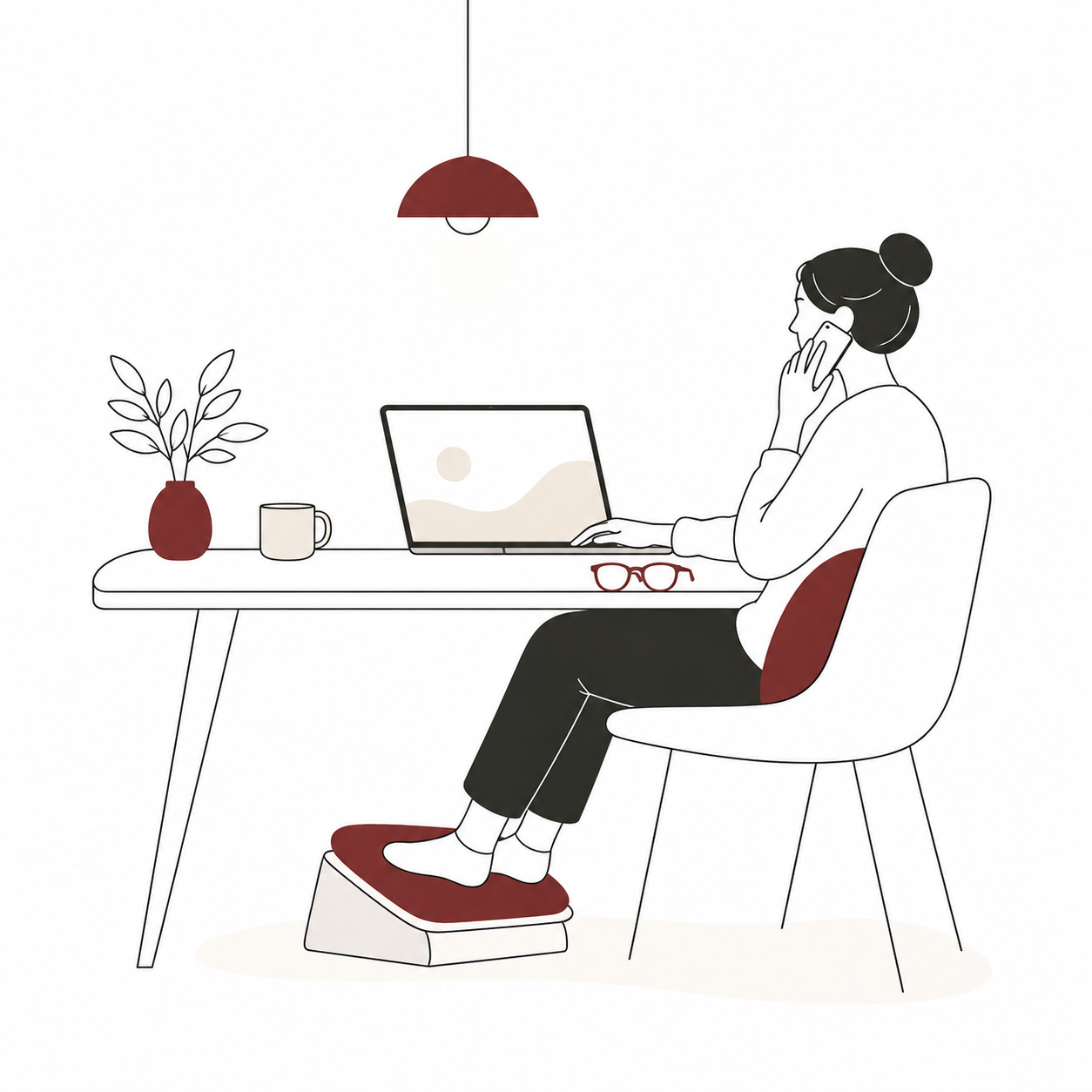
This section mainly refers to cognitive, administrative, commercial, managerial, or computer-based work: calls, emails, planning, coordination, writing, decision-making, meetings, presentations, reporting, or project work. This kind of work may look physically easy from the outside, but it can still place a high load on the nervous system, circulation, cognition, and inflammatory tolerance. Physical work, shift work, standing jobs, care work, hospitality, teaching, or jobs with constant movement may need a different strategy, because the main load may come from being on the feet, lifting, sensory exposure, irregular timing, or lack of control over breaks.
A desk day can be difficult because several systems are challenged at the same time. Dysautonomia can make upright sitting, heat, low fluid intake, blood pooling, long periods without movement, overactivation during calls, and especially moving images in video calls harder to tolerate. ME/CFS or PEM-prone patterns can make cognitive load itself relevant: concentration, decision-making, fast switching, social responsiveness, and time pressure can accumulate even without obvious physical exertion. MCAS or inflammatory reactivity can add another layer, because stress, poor sleep, unsuitable food, overheating, bright light, or sensory input can reduce tolerance further.
Commercial or computer-based work is often underestimated because it is not physically active. But it combines visual load, cognitive load, social load, upright posture, and time pressure. A day full of calls is not just “talking.” It means processing information, reacting quickly, staying socially present, looking at a screen, sitting upright, suppressing bodily signals, and often delaying food, movement, or rest.
Optimising the schedule
One of the first adaptation points is not the amount of work alone, but the way different forms of work are placed next to each other. For many people with limited capacity, especially when cognitive load is a major trigger, several hours of video calls can become much more expensive than the same amount of work spread across different formats.
Where possible, it can help to limit video calls to situations where visual presence or shared material is actually needed, and to move other conversations to the phone. A day that would previously have been a full Teams or Zoom day may work better as a mix of short video calls, telephone calls, written follow-ups, and lower-demand administrative tasks. Demanding cognitive work may also need defined blocks instead of being scattered across the entire day. Decision-making, writing, strategy work, reporting, difficult conversations, and fast switching can all draw heavily from the same limited capacity.
Reducing visual load during screen work
Screen work can be a separate stressor. The problem is not only the content of a call or document, but also the visual processing around it: moving faces, shared screens, changing expressions, notifications, bright backgrounds, multiple windows, and constant switching. For a reactive nervous system, this can become expensive even when the actual topic is not difficult.
One simple adaptation is to reduce how much visual input is actually necessary. If a meeting does not require visual material, a phone call may be easier than Teams or Zoom. If video is expected but not needed for the actual work, audio-only may be enough. If the camera needs to stay on, it can still help not to stare continuously at the moving faces. Looking at a neutral wall, out of a window, at a calm object, or at a static nature image on the screen can reduce the load compared with watching several moving faces at once.
Dark mode, reduced screen brightness, blue-light filters, blue-light glasses, fewer open tabs, a calmer desktop, larger font sizes, and reduced notifications can also help. These adjustments do not change the underlying condition, but they reduce unnecessary input during work that already requires cognitive effort.
Phone calls can also be useful because they allow the body to regulate while the conversation continues. During a call, it may be possible to walk slowly, sit differently, elevate the legs, lie down, look at a blank wall, or close the eyes for parts of the conversation.
Supporting circulation during desk work
For dysautonomia and ME/CFS, desk work can become difficult because the body remains upright and still for long periods. Sitting still may contribute to blood pooling, heavy legs, dizziness, inner agitation, head pressure, fatigue, or a slow decline in concentration.
Concrete adjustments can include standing up once an hour, walking briefly, changing position, using a footrest, elevating the legs under the desk, or lying down during a longer break. Compression socks or compression tights may help on days with more upright time, especially with blood pooling or low blood pressure tendencies. Hydration, electrolytes, salt, and other circulation support may also become more relevant on screen-heavy or meeting-heavy days, where regular movement tends to be difficult.
Using lunch as a reset
For many people, lunch has to be simple. When energy is limited, preparing an ideal meal in the middle of a workday may cost too much. A prepared, tolerated meal can be more useful than trying to make something perfect while already overstimulated or depleted.
If possible, the more relevant part of the break may be what happens after eating: lying down for twenty minutes, elevating the legs, lowering light, closing the eyes, avoiding conversation, taking electrolytes, or using a TENS device if the nervous system is becoming too activated. Especially after a morning with calls, conflict, decision-making, screen exposure, or sensory input, this kind of reset can decide whether the second half of the day remains workable.
Managing in-person meetings
In-person meetings need more preparation because the load is less controllable. Food, travel, walking distances, room temperature, social presence, clothing, noise, and timing all add layers. In that situation, it may be more useful to reduce stress on the system than to aim for a perfect routine.
This may mean preparing tolerated food, bringing electrolytes, using compression, planning taxi use instead of unnecessary walking, reducing additional appointments, and avoiding tight transitions. If there is an evening programme, client dinner, workshop, or business travel involved, the day before and after may need more space. For some people, targeted support for circulation, blood pressure, MCAS-type reactions, or nervous system activation may also be more relevant on these days than on quiet home-office days.
Examples of practical adjustments
- limiting video calls where visual presence is not necessary
- replacing some Teams or Zoom meetings with phone calls
- using audio-only when possible
- looking at a neutral wall, window, or static nature image during calls
- reducing screen brightness and using dark mode
- using blue-light filter glasses
- splitting cognitively demanding work into defined blocks
- standing up or changing position once an hour
- elevating the legs under the desk
- using compression socks or tights on high-upright-time days
- preparing a simple tolerated lunch
- lying down or elevating the legs during the lunch break
- using electrolytes, salt, or circulation support where appropriate
- using TENS or other calming tools when the nervous system is overactivated
- arriving earlier for in-person appointments
- planning fewer obligations around business travel or evening events
- having emergency protocols ready if needed
- taking taxis instead of adding unnecessary walking
- preparing food, supplements, and support items before high-load days
Movement & Regulation
Click here to read more
Whether out of choice or necessity, movement often has to return before the system is strong enough for anything close to a previous training baseline.
This section is not about performance training, fitness goals, or rebuilding the body as quickly as possible. It is about keeping some form of movement available without destabilising the system. In unstable phases, even the idea of a fixed exercise programme can become too expensive: planning it, getting ready, travelling there, following instructions, tracking progress, and recovering afterwards may use energy that is already needed for work, food, household tasks, travel, or basic regulation.
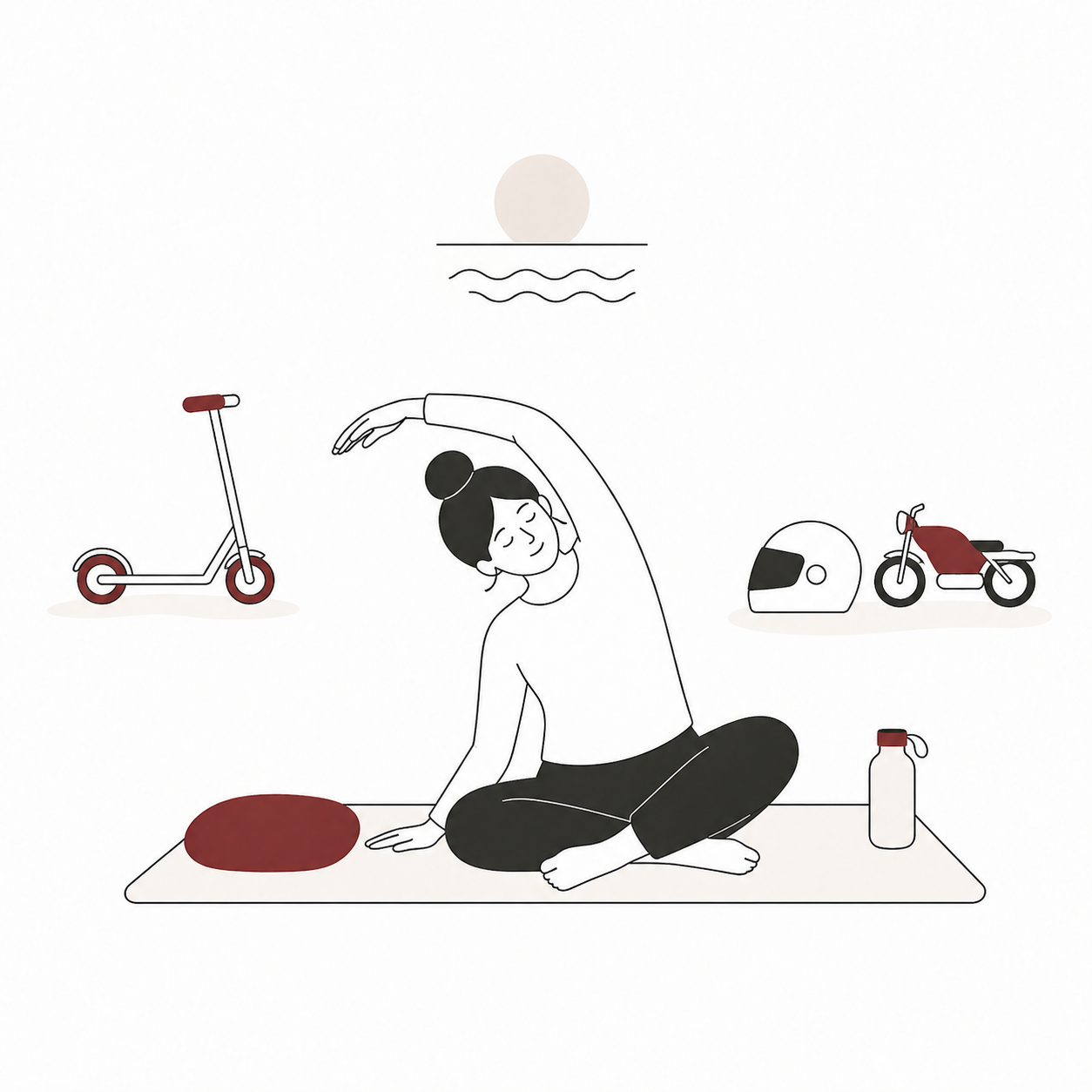
The main shift is simple: it is often better to do very little consistently than to force a workout the body cannot absorb. A few movements on a mat, gentle stretching, moving while making coffee, standing up briefly, walking through the room, or loosening the body for two minutes can be enough. This is not “nothing”. It keeps circulation, body awareness, and mobility present without adding a full training demand.
Reducing orthostatic stress
For dysautonomia, useful movement often means reducing orthostatic stress. Walking, standing, heat, stairs, fast position changes, and long upright phases can be harder than they look. Helpful adaptations may include compression socks or tights, electrolytes, salt or circulation support where appropriate, sitting-based movement, reducing unnecessary walking, and using mobility adaptations for longer distances when needed.
Warm water, thermal baths, gentle swimming, floating, or pool walking can also be useful for some people because water provides natural compression and reduces upright load. The point is not to turn water into another training programme. The point is to use it when it helps the body regulate without adding unnecessary strain.
Movement and total load
For ME/CFS or PEM-prone patterns, movement has to be judged against the total load of the day. If work, travel, social interaction, poor sleep, inflammation, or sensory input already used most of the available capacity, movement may need to shrink. That is not regression. It is load management.
On some days, the movement may already be airport walking, carrying luggage, walking to an appointment, standing in a queue, or doing basic household tasks. Adding exercise on top may be the problem. In those phases, the relevant question is not whether the body moved “enough”, but whether the total load remained absorbable.
Choosing regulating forms of movement
Useful options can include gentle home movement, warm water, mid-temperature thermal baths, slow swimming without distance goals, gentle horse riding at walking pace, light bouldering instead of gym training if tolerated, motorbike riding as rhythm, focus, posture work and regulation, or short movement breaks during the day.
The form matters less than the effect. Movement should ideally support regulation, circulation, orientation, and body awareness. If it creates delayed worsening, wired exhaustion, heavy legs, dizziness, inner agitation, or next-day collapse, it may need to become smaller, slower, shorter, or better supported.
Early emergency reset
If movement was too much, it helps to treat it early instead of waiting for a full crash. An emergency reset may mean lying down, elevating the legs, using electrolytes or salt, cooling the body, reducing light and noise, using compression, using a TENS device or another calming tool, eating something simple if blood sugar feels unstable, and cancelling the next non-essential load.
The aim is to bring the system back down before symptoms accumulate further. Recovery after movement is not a failure of discipline. It is part of the cost calculation.
Examples of practical adjustments
- dropping fixed training expectations
- choosing movement by current state, not by old identity
- doing a few exercises instead of following a full programme
- treating travel, errands, stairs, and standing time as real physical load
- reducing walking when orthostatic symptoms are strong
- using a scooter, bike-like option, taxi, or other adaptation for longer distances
- using warm water, thermal baths, floating, gentle swimming, or pool walking
- using gentle riding, motorbike riding, or similar activities as regulation when tolerated
- using compression, electrolytes, salt, or circulation support where appropriate
- avoiding additional movement on already demanding days
- using an emergency protocol early if symptoms escalate
- allowing movement to shrink again when work, travel, or responsibilities require more energy
Meals & Food Strategy
Click here to read more
This section is not about building the perfect diet. It is about reducing avoidable load. In a reactive system, food can support stability, but it can also become an additional stressor: through histamine reactions, lectin load, inflammatory responses, blood sugar swings, digestion demands, preparation effort, decision fatigue, or the stress of trying to eat “correctly” when the body has very little capacity left.
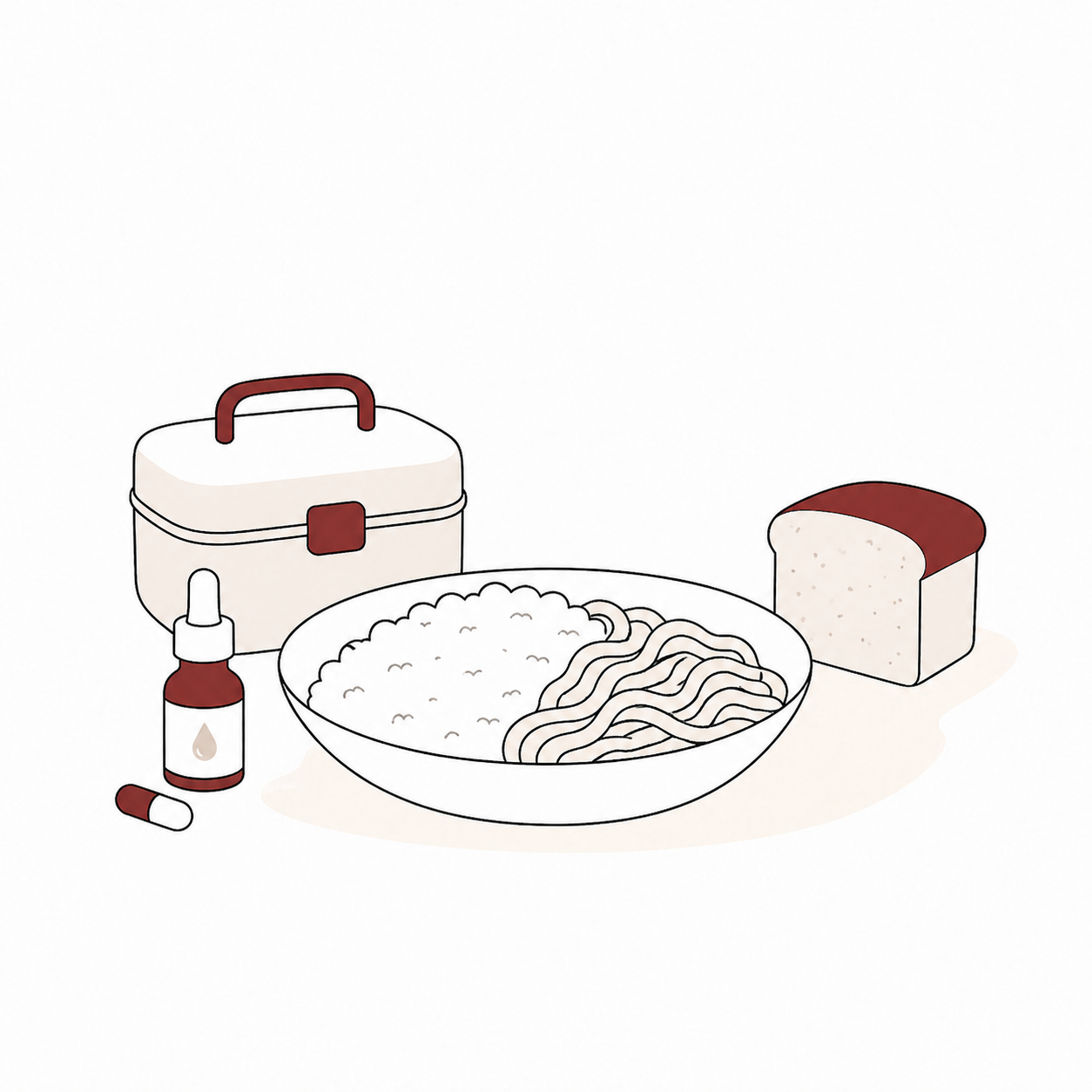
The main priority is tolerance before perfection. A simple, well-tolerated meal can be more useful than a nutritionally ideal meal that triggers symptoms. For example, white rice, rice noodles, tolerated bread, or a very simple salad may be more stabilising than whole grains, legumes, fermented foods, leftovers, or “healthy” foods that create reactions. This does not have to be a long-term ideal. It can be a functional phase: lower the noise, reduce inflammation where possible, and make eating predictable enough that the body does not have to fight every meal.
Keeping food repetitive at home
At home, repetition can be useful. Eating similar meals reduces decisions, shopping complexity, preparation effort, and risk. This is especially relevant when work, travel, dysautonomia, ME/CFS-type fatigue, MCAS reactions, or inflammatory symptoms already use most of the available energy.
A practical structure may be very simple: a prepared smoothie base in the morning, a quick tolerated lunch, and an easy evening meal. The point is not variety for its own sake. The point is to have enough reliable options that eating does not become a daily project.
For some people, this may mean a smoothie with pre-mixed powders prepared for one or two weeks. For others, it may mean tolerated bread, rice noodles that only need hot water, simple salads, rice, steamed vegetables, or a few safe fats and proteins. The exact foods are individual. The principle is the same: reduce friction.
Histamine, lectins, and individual tolerance
During unstable phases, it can help to think less in terms of general food rules and more in terms of personal reaction patterns. Histamine and lectins may be relevant for some people, especially when the total load is already high. A food that is tolerated on a calm day may become too much after poor sleep, stress, travel, heat, infection, hormonal shifts, or intense work.
Meal prep can also become complicated. Preparing food in advance saves energy, but leftovers may increase histamine load for some people. In that case, freezing directly after cooking may work better than keeping meals in the fridge for several days.
The same applies to “healthy” options. Nuts, legumes, fermented foods, whole grains, raw vegetables, or leftovers may be useful for one person and destabilising for another. The relevant question is not whether a food is theoretically healthy, but whether it is usable in the current phase.
Food outside the house
Outside the house, the goal is often not perfect eating. The goal is to avoid being trapped without a safe option. Bringing one or two reliable basics can change the situation completely: tolerated bread, a simple snack, electrolytes, vitamin C, or another personal support item.
This makes it easier to combine external food with safe food. For example, buying a simple salad and adding tolerated bread may be more realistic than trying to find a perfect meal while already overstimulated or hungry. On travel days, business days, or in-person appointments, this can reduce pressure on the system.
Hotel breakfasts, restaurants, airports, client dinners, or family meals often come with limited control. In those situations, the useful strategy may be to eat the safest available option, add your own food where needed, and avoid turning every meal into a stress test. If eggs, rice, salad, fruit, bread, or another simple option is tolerated, that may be enough for that moment.
Support when food is not ideal
Sometimes eating will not be ideal, either because ideal food is not available or because you choose to “eat normal” for once. That is part of real life. The aim is to have support ready instead of needing to improvise while already reacting.
Depending on the person, this may include vitamin C for histamine load, H1 or H2 blockers if medically appropriate, D-mannose when lectins are an issue, electrolytes, salt, or other individual support. This is not about creating a complicated routine around every meal. It is about having a fallback when travel, work, restaurants, or social situations make food less controllable.
The practical logic
Food can stabilise, but food management can also drain energy. During limited phases, the best strategy is often not the most impressive one. It is the one that can actually be repeated.
- keeping a small list of safe meals
- repeating meals without guilt
- prioritising tolerated foods over theoretically ideal foods
- using simple carbs if they are better tolerated than “healthier” alternatives
- preparing smoothie powders or basics in advance
- using quick lunches that require minimal preparation
- freezing cooked food directly if histamine is an issue
- carrying safe bread, snacks, or travel food
- combining bought food with your own tolerated food
- avoiding restaurant or hotel food when it adds too much stress
- keeping vitamin C, electrolytes, H1/H2 blockers, D-mannose, or other personal support available where appropriate
- accepting that food may need to be boring for a while if boring means stable
Family Responsibilities
Click here to read more
Family duties are often different from optional social plans. They are less flexible, less easy to cancel, and often emotionally harder to reduce. Care obligations, household tasks, children, pets, shared living, family expectations, and basic domestic routines may continue even when work, sport, travel, or social activities have already been cut down.
This is why the goal often shifts from doing more to preserving the base: keeping essential life functioning without repeatedly pushing the system into overload.
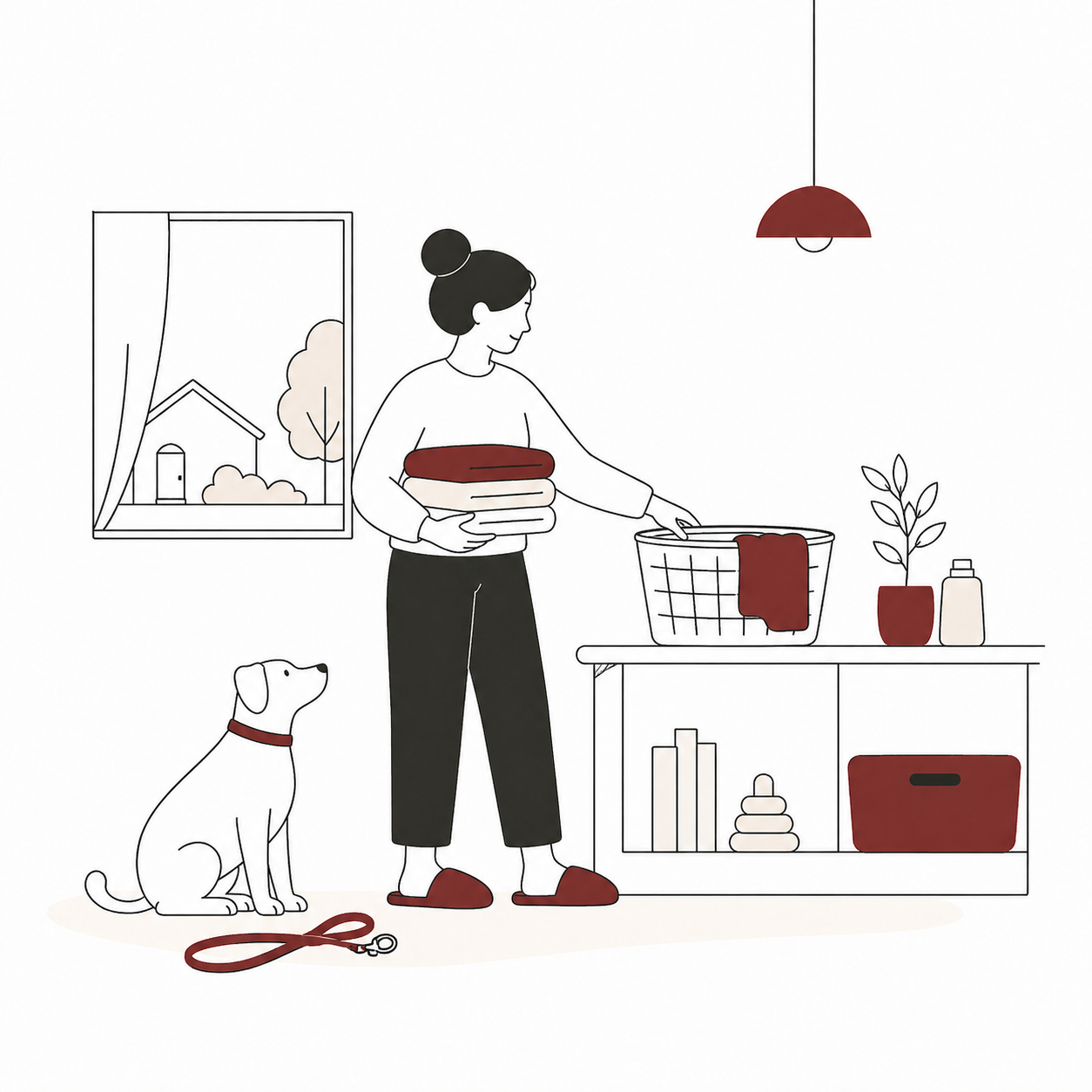
For dysautonomia, ME/CFS, PEM-prone patterns, MCAS, or inflammatory reactivity, the problem is rarely one single task. It is the accumulation. Picking someone up, walking the dog, doing laundry, preparing food, answering family needs, cleaning, organising, and being emotionally available can become a full load category.
These things may look small from the outside, but they still involve standing, walking, bending, decision-making, sensory input, timing pressure, and nervous system activation.
Simplifying movement inside family life
Movement in a family context may need to become more practical and less idealistic. If walking to pick up a child would cost too much, taking the car can be the better adaptation. If long dog walks are not currently realistic, using a bicycle, choosing a shorter route, or using the garden may preserve the basic responsibility without turning it into a full exertion block.
The point is not to add movement on top of family life. The point is to make necessary movement less expensive. During unstable phases, integrated movement is often more realistic than planned exercise.
Protecting recovery time
Short free windows may need to be used differently than before. A spare thirty minutes does not automatically mean sport, productivity, cleaning, messages, or catching up. It may need to mean lying down, reducing input, elevating the legs, eating something simple, or doing nothing.
This can be difficult because family life often creates the feeling that every free moment should be used. But when the system is limited, recovery is not empty time. It is what keeps the base functional.
Reducing household complexity
Household tasks can often be simplified without disappearing completely. Wearing similar clothes, choosing easy-to-wash items, reducing ironing, repeating outfits, using fewer categories, keeping routines standardised, and accepting less detail work can lower daily friction.
The same logic applies to cleaning, laundry, shopping, and food preparation. The question becomes: what is the simplest version that still works? Not the best version. Not the most aesthetic version. The version that keeps life moving without draining the system.
Doing less without disappearing
The aim is not always to hand everything over or withdraw completely. Sometimes the more realistic solution is to keep participating, but in a reduced form. Smaller tasks, simpler routines, shorter involvement, fewer standards, and more predictable structures can allow a person to remain present without pretending to have full capacity.
This matters because family responsibilities often carry guilt. But doing less is not the same as not caring. In a limited phase, simplified participation may be the more sustainable form of reliability.
Accepting the trade-off
When family responsibilities remain, they use energy first. That means there may be less capacity for sport, social life, creative work, personal projects, or active recovery. This is not always a planning failure. It can be the structural reality of a limited system.
Practical adjustments
- taking the car instead of walking when the walk would cost too much
- using a bike or shorter routes for dog-related movement
- using the garden instead of forcing long walks
- treating household movement as valid movement
- using short free windows for real recovery, not automatic productivity
- simplifying clothing and laundry routines
- reducing ironing, outfit complexity, and unnecessary household standards
- repeating meals, routines, and task structures
- doing smaller versions of necessary tasks
- accepting fewer details and less perfection
- protecting quiet time after family-heavy periods
- reducing extra commitments when family load is already high
- staying present in simpler ways instead of disappearing completely
Travel & Logistics
Click here to read more
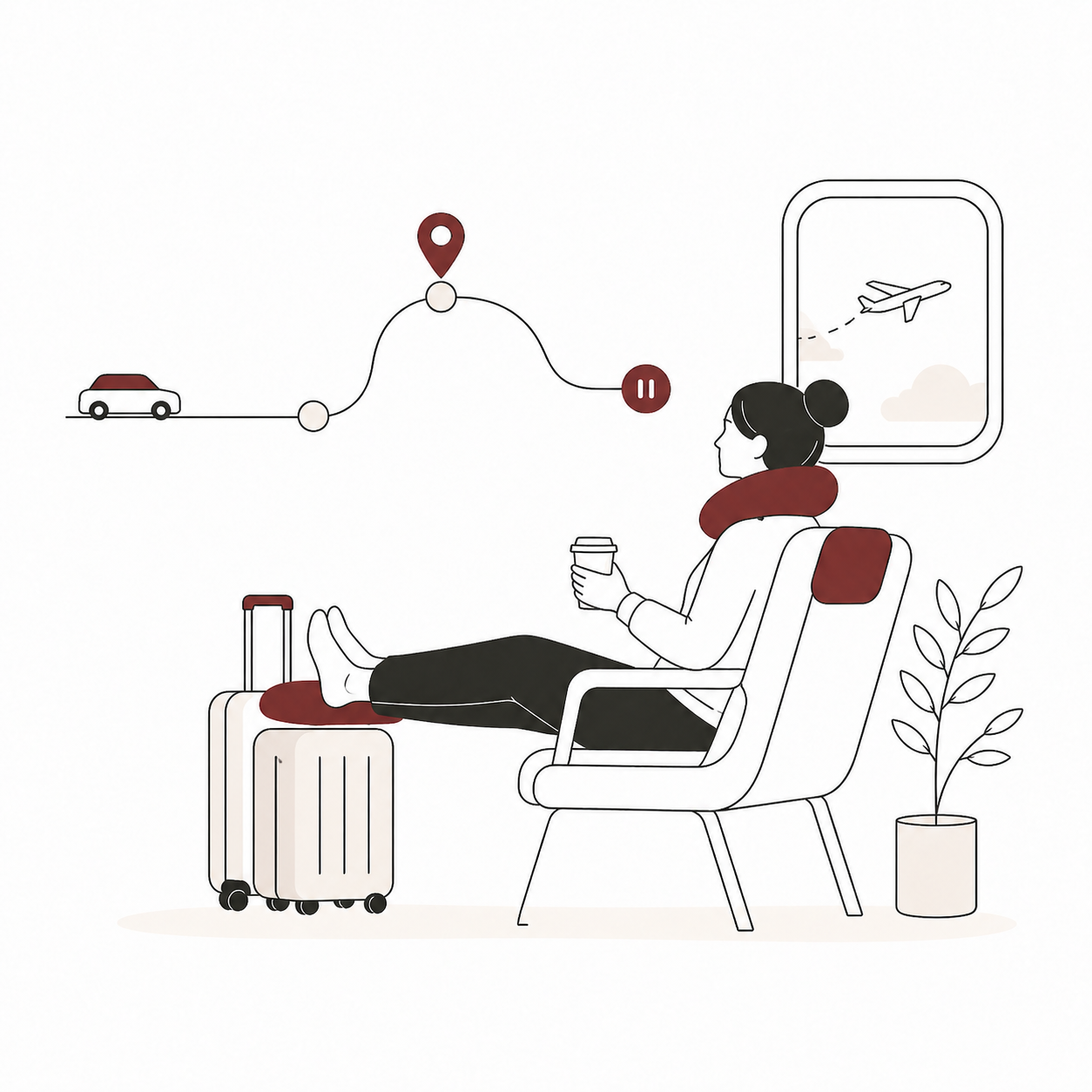
Travel is rarely just “getting from A to B.” It combines movement, upright time, circulation demands, sensory input, food uncertainty, temperature changes, luggage, planning, social interaction, and cognitive load. For dysautonomia, long walking distances, standing, heat, dehydration, blood pooling, and rushed transitions can quickly become destabilising. For ME/CFS or PEM-prone patterns, the total load of the travel day matters: packing, timing, navigation, airport processes, meetings, meals, conversations, and recovery afterwards can all accumulate. MCAS or inflammatory reactivity can add another layer when heat, stress, unsuitable food, poor sleep, or unfamiliar environments reduce tolerance.
The aim is not to make travel perfect. The aim is to remove unnecessary load so that the trip itself does not consume all available capacity.
Business or necessary travel
Business travel needs more scaffolding than ordinary office work, because the travel itself is already part of the workload. It may help to use taxis or get dropped off instead of adding public transport, long walks, or parking stress. At airports, wheelchair assistance can be a practical tool because it reduces walking, standing, queues, and unnecessary circulatory strain.
For flights, an aisle seat can make it easier to move, stretch the legs, access the toilet, and support circulation. Compression clothing, fluids, electrolytes, salt, and circulation or blood-pressure support may become more relevant than on a normal day. Simple, tolerated food is often more useful than relying on airport food. Sugar snacks or other fast, easy options can also be useful when short-term stability matters more than ideal nutrition.
Work during travel should be reduced where possible. A travel day is already a load day. Calls may be easier by phone than video, legs can sometimes be elevated on luggage, and productivity may need to stay close to the minimum. After appointments, taxis can be more stabilising than adding unnecessary walking. The main point is to save capacity for the essential parts of the trip.
Car travel
Car travel can be easier than flying because there is more control, but it still needs pacing. Long drives may need more stops, slower planning, and less pressure than before. Breaks can include lying down, elevating the legs, using a mattress in the car, drinking, eating something simple, or using circulation support if that is part of the individual protocol.
On longer trips, it can make sense to plan layovers more flexibly. Instead of forcing a fixed distance, spontaneous stops allow the route to reflect the actual energy level during the drive.
Cognitive load also matters while driving. Calls, complex podcasts, intense content, or constant music may be too much on some days. Lighter input, silence, simple audiobooks, or low-stimulation content can make the drive less expensive for the nervous system. More time means more options. Less pressure usually means fewer crashes.
Private travel
Private travel is not automatically easier just because it is “for fun.” It can require the same kind of structure as business travel. Spontaneous booking can be useful when the actual state of the body determines how far it is realistic to go. A calmer location, a cool room, the ability to open a window, and enough quiet time can matter more than a perfect itinerary.
Accommodation should support recovery, not only sightseeing. When travelling with a partner, two rooms or an Airbnb with enough space can make a major difference. The ability to withdraw, rest separately, eat simply, and avoid constant interaction can keep the trip more stable. Dense programmes, complicated restaurant situations, hotel breakfast stress, and too many transitions can quickly turn a holiday into another load block.
Instead of classic sightseeing in the heat, hotel-based holidays, or crowded club-style travel, camping or renting an apartment may often be more suitable. These formats usually offer more control over food, rest, timing, stimulation, and personal space. If heat is poorly tolerated, it can also be useful to choose cooler regions, travel in cooler seasons, or structure activities around the cooler parts of the day.
Motorbike travel
Motorbike travel sits between movement, regulation, and travel. It can be possible and even stabilising, but only with adaptations. Compression boots or tights, adjusted footrests for better blood flow, regular stops, standing up, moving the legs, and planned rest breaks can reduce circulatory strain. A blanket or simple setup for lying down during breaks can make longer rides more realistic.
Cooler regions may be easier than heat. Food should stay simple and prepared where possible, because the ride itself already uses capacity. The goal is not to ride in the old performance mode. The goal is to keep the regulating parts of motorbike travel while reducing the unnecessary physiological cost.
Practical adjustments
- using taxis instead of adding unnecessary walking
- using airport wheelchair assistance
- choosing an aisle seat
- wearing compression clothing on high-upright-time days
- bringing electrolytes, fluids, salt, and circulation support where appropriate
- packing simple tolerated food
- carrying fast, easy sugar snacks for short-term stability
- elevating the legs on luggage when possible
- splitting long drives into slower segments
- taking more stops than before
- lying down or elevating the legs during car breaks
- using low-stimulation audio instead of complex input
- booking quieter accommodation with recovery space
- avoiding dense programmes and tight transitions
- using two-room setups or separate rest space when travelling with a partner
- choosing camping, apartments, or flexible accommodation when they offer more control
- travelling to cooler regions or during cooler seasons when heat is poorly tolerated
- keeping food simple instead of making restaurants another stressor
- carrying emergency protocols and support items in an accessible place
- using compression boots, adjusted footrests, regular stops, and rest breaks for motorbike travel
Body Support
Click here to read more
Managing personal protocols and general body support often becomes more important once activity, work, travel, or social life start to increase again.
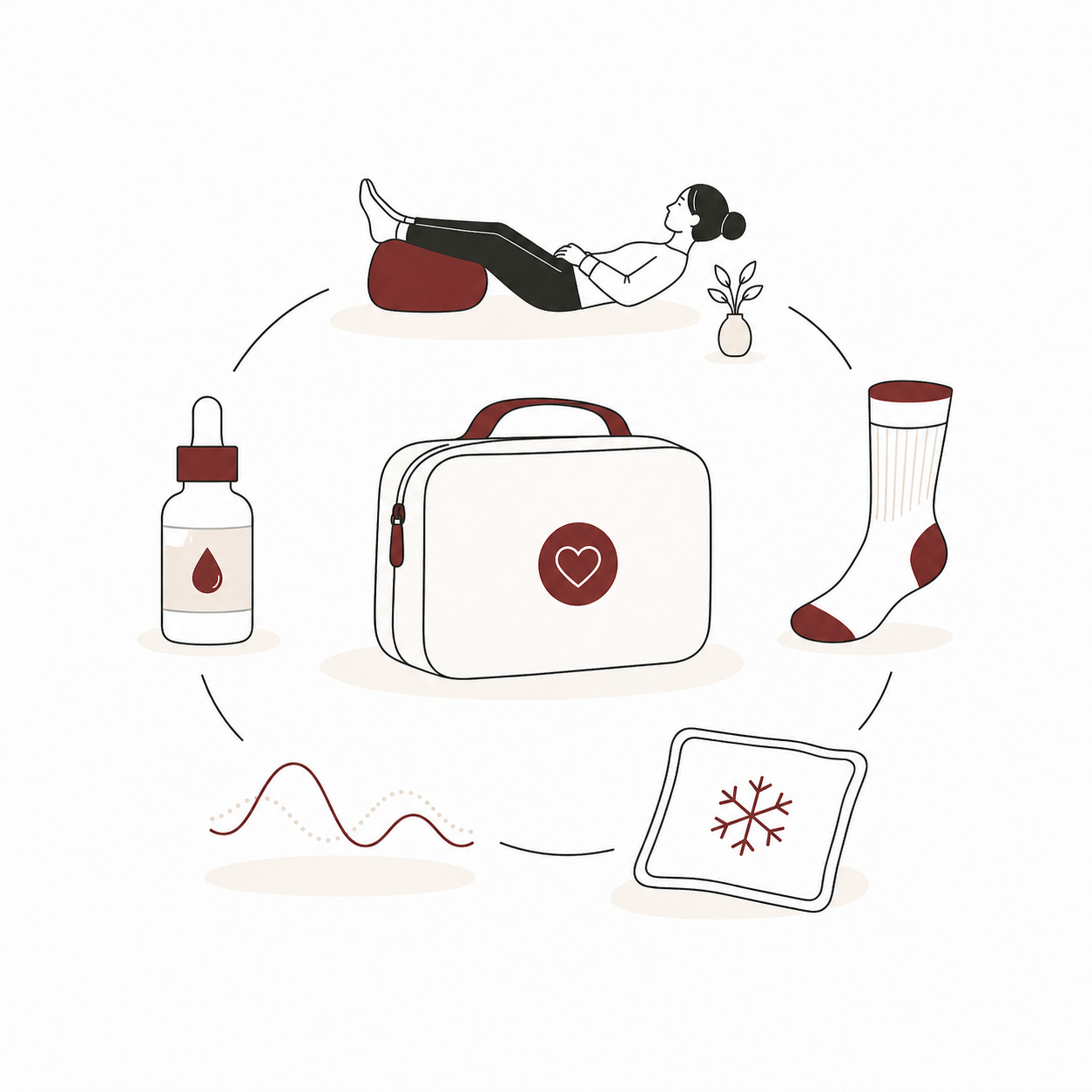
This section refers to the practical layer that helps keep the system stable enough to participate: compression, electrolytes, salt, cooling, supplements, TENS, rest positions, lymphatic support, and emergency routines. These tools do not replace recovery, pacing, medical care, or deeper treatment. But for many people with dysautonomia, ME/CFS, PEM-prone patterns, MCAS, or inflammatory reactivity, they become part of the scaffolding that makes daily function possible.
The difficult part is that support itself costs energy. Preparing supplements, remembering electrolytes, packing compression, carrying tools, managing temperature, and reacting early enough all require planning. This is why the most useful support is often not the most complex support. It is the support that is prepared, easy to reach, and simple enough to use when the system is already under stress.
Preparing support before it is needed
Body support works better when it does not have to be improvised during overload. A practical approach can be to prepare the recurring basics every one or two weeks: supplements, electrolytes, salt, compression items, small stabilising tools, and anything needed for predictable higher-load days.
Keeping these items in one small bag or set can reduce the amount of thinking required in daily life. The aim is not to create a perfect protocol. The aim is to make the basics immediately available before the system tips.
Keeping support mobile
Support is often needed outside the house, not only in an ideal home setting. That means the relevant items may need to be available in the car, on the motorbike, at work, in a hotel room, at the airport, or on a plane.
This matters because many destabilising situations happen during transitions: travel, heat, long upright time, business appointments, social events, or days with too much stimulation. Having electrolytes, salt, compression, supplements, or calming tools available early can prevent a small decline from becoming a larger crash.
Layering several small supports
Body support often works through combination, not through one impressive intervention. On higher-load days, it may mean electrolytes plus salt, compression plus more rest positions, cooling plus reduced stimulation, supplements plus TENS, or circulation support plus lying down with the legs elevated.
This layered approach is especially relevant for dysautonomia and nervous system overactivation. If the body becomes wired, dizzy, shaky, heavy, hot, restless, or unstable, simple physical measures may matter: feet up, less light, less input, a calmer position, TENS if useful, and targeted support that is already prepared.
Managing temperature
Heat can become a major stressor. It can worsen circulation, increase fatigue, raise nervous system activation, and reduce tolerance for other loads. Temperature management may therefore be part of basic support, not just comfort.
This can include sleeping cool, choosing cooler environments where possible, avoiding unnecessary heat exposure, using electrolytes and circulation support on hot days, and planning demanding activities around temperature rather than only around time.
Supporting fluid movement and lymph
For some people, fluid retention, heaviness, swelling, or lymphatic sluggishness becomes part of the wider body-support picture. Gentle movement, replacement movement, rest positions, and sometimes lymph drainage can help reduce load. A lymph drainage device may also be useful in some phases if it creates relief and parasympathetic downshifting.
This is not about adding another demanding routine. It is about using support when it genuinely makes the body feel less congested, less heavy, or less activated.
Emergency layer
It can be useful to separate everyday support from an emergency layer. Everyday support covers the basics. The emergency layer is for situations where the system is already tipping or where the load is predictably higher.
This may include stronger circulation support, additional electrolytes, calming tools, TENS, extra supplements, prescribed emergency medication, or anything personally known to help the body come down. Keeping this in a separate prepared bag can reduce panic because the next step is already clear.
Practical adjustments
- preparing supplements and support items every one or two weeks
- keeping electrolytes, salt, compression, and key tools in one small set
- having support available at home, in the car, while travelling, and during appointments
- using compression clothing on high-upright-time days
- using electrolytes and salt before or during higher-load days
- elevating the legs when circulation starts to drop
- lying down before symptoms escalate further
- using TENS when nervous system activation becomes too high
- cooling the body and reducing heat exposure where possible
- sleeping in a cooler environment when heat worsens symptoms
- using lymphatic support when fluid retention or heaviness becomes relevant
- separating everyday support from an emergency bag
- placing support earlier on predictable high-load days instead of waiting for collapse
Many of these measures are invisible from the outside. But they can be the difference between participating and destabilising. Body support is not about making the body perform beyond its capacity. It is about reducing avoidable stress so the current capacity can be used more safely.
People & Social Energy
Part of living again often means allowing some form of social life back in before the system is fully stable.
Useful adaptations can make interaction more manageable by reducing sensory load, food-related stress, standing time, emotional demand, and delayed recovery cost.
Click here to read more
Social interaction can be its own load category. It is not only “seeing people.” It can combine cognitive processing, emotional regulation, sensory input, posture, food decisions, noise, temperature, social performance, travel, and recovery cost.
For dysautonomia, social settings can become harder when they involve standing, heat, long sitting, alcohol, irregular meals, walking distances, or no place to reset. For ME/CFS or PEM-prone patterns, the problem is often total load: talking, reacting, listening, switching attention, masking symptoms, and staying present can accumulate even when the event feels pleasant. MCAS or inflammatory reactivity can add another layer through food, alcohol, stress, poor sleep, histamine load, overheating, or sensory stimulation.
This is why social energy is often underestimated. A dinner, birthday, family visit, wedding, or business-related social event may look like leisure, but for a reactive system it can become a demanding multi-system task.
Choosing the form of interaction
Not every social contact has to happen in the most expensive format. A phone call may be easier than an in-person meeting. A short visit may be better than a full evening. Cooking together at home may be easier than a restaurant if food is a major trigger. A quiet setting may be more tolerable than a loud room with many people, music, heat, and constant movement.
The point is not to avoid all social life. The point is to choose the form that gives the highest value with the lowest avoidable load.
Food, restaurants, and participation
Food can decide whether a social setting remains manageable. Restaurants are easier when there are tolerated options. If not, it may be better to choose another setting, eat something safe beforehand, bring a small addition such as tolerated bread, or keep the meal simple instead of trying to eat perfectly.
The aim is not perfect nutrition in every social situation. The aim is to avoid preventable reactions while still being able to participate. Sometimes this simply means having a small toolbox ready to help the body cope with potential stressors.
Larger events
Bigger events need more scaffolding because they combine several triggers at once: people, noise, food, standing, heat, alcohol, late timing, emotions, travel, and lack of control. Weddings, Christmas, larger family gatherings, client dinners, workshops, or celebrations may still be possible, but they should not be treated like normal days.
Preparation can include electrolytes, compression, tolerated food, vitamin C, magnesium or potassium, individual supplements, prescribed emergency medication where relevant, and a clear recovery buffer afterwards. It can also help to plan where to withdraw: a hotel room, car, quiet corner, outside space, or another place where the legs can be elevated and input reduced.
Some events may have special meaning, such as the wedding of someone close, a major birthday, or a day that is important to your children. In those cases, it may even make sense to seek professional support before and after the event, for example IV support such as vitamin C or magnesium where medically appropriate. I do not think relying on heavier interventions should become the norm or the goal, but they can be useful if we want to participate in important gatherings before the body has fully recovered.
Alcohol and compensation
Alcohol is not automatically impossible, but it can be costly. Histamine load, sleep disruption, blood pressure effects, MCAS-type reactions, and next-day instability can matter. Some people tolerate certain options better than others, for example white wine better than red wine, but this is individual.
If alcohol is used consciously, support may include water, electrolytes, vitamin C, food, histamine-related support such as DAO where appropriate, or H1/H2 blockers if medically suitable. This should not become a routine justification to override limits, but it can be part of realistic planning for specific situations.
Aftercare
Social effects can be delayed. The body may not crash during the event, but later that night, the next morning, or one to two days afterwards. This is especially relevant with PEM-prone patterns, dysautonomia, MCAS, poor sleep, alcohol, or long sensory exposure.
Aftercare may mean no major plans the next day, lower screen load, simple food, hydration, electrolytes, quiet time, lying down, TENS, compression, or simply not forcing the body back into normal speed immediately.
Examples of practical adjustments